Remote, Hybrid, or On-Site? Executive Career Tradeoffs That Shape Your Next Move
Return-to-office is no longer a small detail in executive hiring. It can shape visibility, access, influence, and how quickly a leader builds momentum in a new role.
This is not an argument for office work or against remote work. It is a career strategy question.
For directors, vice presidents, and C-suite leaders, the work model is not only about location. It affects how leadership is observed, how relationships form, how decisions move, and how much control the executive has over time and energy.
The right model depends on the chapter the leader is in. Faster advancement may require one set of tradeoffs. A portfolio career, board path, advisory work, health priorities, or family stage may require another.

What Makes Work Model Choice Different at Senior Levels?
At senior levels, work model choice is not only about productivity.
Executives are evaluated through presence, judgment, influence, availability, and how they handle moments that are not always scheduled. A leader may do excellent work remotely and still miss informal conversations where trust, sponsorship, and future opportunity develop.
That does not make remote or hybrid work weak. It means senior leaders need to understand what each model gives them and what each model makes harder.
The question is not simply, “Can I do the job from here?”
The better question is, “Can I build the influence, access, and momentum this next chapter requires?”
The Career Tradeoff Behind Remote, Hybrid, and On-Site Work
The working model a senior leader chooses can affect four areas of career growth.
- Visibility: Who sees the leader make decisions, handle pressure, and build trust?
- Access: Who includes the leader in informal conversations and early-stage decisions?
- Energy: How much time and attention does the leader protect for focused work, health, family, and recovery?
- Optionality: Does the model support the next move, a board path, advisory work, fractional leadership, or a consulting platform?
What On-Site Work Can Create for Advancement
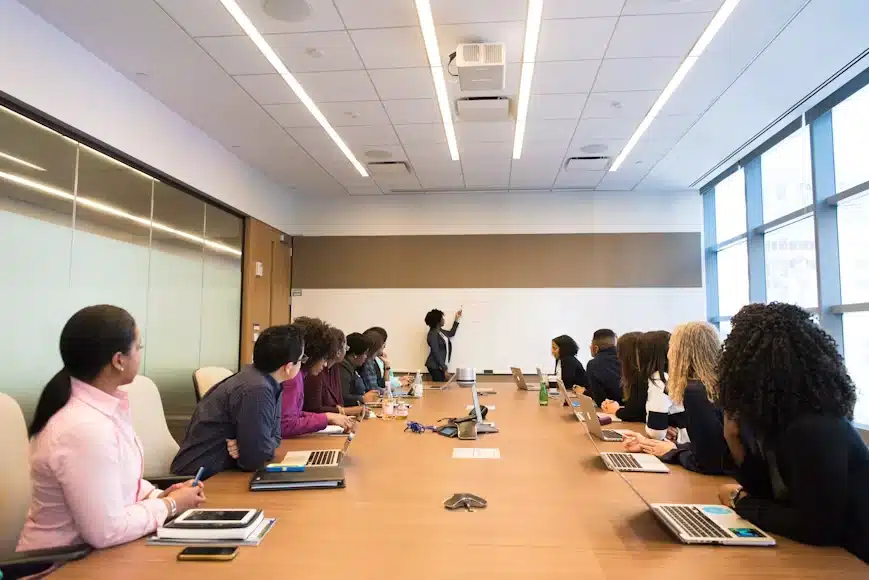
On-site presence can create relationship density faster.
At senior levels, the question is not only whether the executive can perform. It is whether others see the leader’s judgment, composure, influence, and readiness for broader scope.
Office presence can place leaders closer to informal moments that shape trust. These moments may happen after a meeting, before a difficult call, during a hallway reset, or inside a quick conversation that never appears on the calendar.
Those interactions can accelerate sponsorship. They can help peers, direct reports, senior leaders, and board-facing stakeholders experience the executive’s leadership in real time.
Remote leaders can build strong relationships too. But those relationships usually require more deliberate cadence, more intentional communication, and more consistent follow-through.
At senior levels, visibility and access often shape opportunity as much as results do.
What Remote and Hybrid Work Can Return
Remote and hybrid work can return more than commute time.
They can reduce transition time, protect focused work blocks, and make it easier to manage health, family, and recovery in demanding leadership roles. For some executives, that time can improve decision quality because the week has fewer forced interruptions.
The commute is only the visible cost. The hidden cost often includes preparation, travel friction, parking, arrival time, decompression, and the reverse trip home.
For senior leaders, the value is not simply convenience. It is control over the hours that carries the most strategic weight.

How Work Models Affect Portfolio Careers
Remote and hybrid models can make portfolio careers more realistic.
More senior leaders are building careers that include advisory work, board service, fractional leadership, speaking, consulting, or thought leadership. This only works when boundaries are clear and the employer is aligned.
The advantage is not working less. The advantage is having more control over high-value time.
Executives still need to protect trust. Outside work must not create conflicts, distract from the role, or weaken credibility with the employer. But when the structure is clear, flexible models can support a broader career chapter.
What Each Work Model Gives and Costs
On-site work can cost time, energy, recovery, family flexibility, and space for outside opportunities.
Remote work can cost visibility, informal access, relationship density, and speed of trust.
Hybrid work can cost clarity if the company says it supports flexibility but still makes important decisions around in-office presence.
None of these models is automatically better. Each one creates a different leadership environment. Senior leaders need to decide which tradeoff supports the next chapter best.

How to Make Each Model Work Better
On-site work requires intentional sustainability.
Executives need to protect energy, focus time, and personal priorities so visibility does not come at the cost of long-term performance.
Remote work requires intentional visibility.
Executives need consistent communication, stronger follow-up, and deliberate relationship-building so their leadership does not become invisible.
Hybrid work requires intentional presence.
Executives need to know which meetings, decisions, and relationship moments require in-person attendance. Hybrid works best when presence is planned, not random. The model only works when the leader builds habits that offset what the model naturally weakens.
What Weakens Executive Work Model Decisions
Avoid these patterns:
- Accepting a role based on the written policy without understanding the real culture.
- Assuming hybrid means equal visibility.
- Choosing remote work without a plan for relationship building.
- Choosing on-site work without accounting for energy and personal sustainability.
- Ignoring how the model affects promotion speed.
- Treating flexibility as only a lifestyle choice.
- Treating office presence as automatic influence.
- Failing to ask where decisions actually happen.
- Underestimating how the model affects the next career chapter.
Questions That Clarify the Right Work Model
The right model becomes clearer when the executive is honest about what they are optimizing for and what they are willing to trade.
- What am I optimizing for in the next 12 to 24 months?
- Do I need faster advancement, stronger visibility, better balance, or more flexibility for a portfolio career?
- Where are key decisions made in this organization?
- How do senior leaders build trust in this company?
- Will remote or hybrid work affect access to the CEO, board, peers, or high-visibility projects?
- What moments require in-person presence for this role to succeed?
- What leadership moments cannot be handled well from a distance?
- What am I gaining with this model?
- What am I giving up?
- Can I build the relationships this role requires from this work model?
- Does this model support the chapter I am actually trying to build?
Key Takeaways
- Remote, hybrid, and on-site work models affect more than location.
- At senior levels, work model choice can shape visibility, influence, sponsorship, energy, and advancement speed.
- On-site work can build trust and informal access faster.
- Remote and hybrid work can return time, focus, flexibility, and space for broader career goals.
- Hybrid only works when company habits match the policy.
- Executives should evaluate both the advantages and the costs of each model.
- The right choice depends on the chapter the leader is building next.
- Remote work requires a visibility plan, while on-site work requires an energy plan.
Final Thoughts
The strongest executives do not treat work model choice as a simple preference. They treat it as a career strategy decision.
On-site work can accelerate access, trust, and visibility. Remote work can protect time, focus, and flexibility. Hybrid work can offer balance, but only when the company’s habits support it.
The right answer depends on what the leader needs most in the next chapter.
The goal is not to ignore the tradeoffs. It is to choose them consciously, plan for what they cost, and lead in a way that keeps momentum moving.
Question: What would you tell a senior leader who is choosing between flexibility today and faster advancement tomorrow?